Wednesday, 22 August 2012

Vacation on Zanzibar

Africa was a bit difficult and expensive to travel and, at the risk of sounding spoiled or ungrateful, after almost 7 months on the road we felt the need for a vacation. Zanzibar seemed like the perfect place so we parked ourselves on the beach for a week and did a whole lot of nothing. It was just what we needed.
We spent two nights in the main city of Stone Town before heading to a much smaller village called Paje on the east coast. We were so lucky to meet Suleimon, our host for the next 6 nights at his quiet little "Masika Guesthouse" where we were two of only three guests the whole time. Suleimon also happened be an Italian-trained chef which played well into our plan of doing nothing since he cooked all of our meals during our stay for a small fee :) We enjoyed mounds of fresh fruit every morning and feasts of fresh seafood each night. During the days we alternated from the hammock to the beach and from reading to napping with a lot of beach walking & swimming in between. Here are some photos:
Great view from the plane to Tanzania of Mount Kilimanjaro and her little sister Mount Meru, peaking above the clouds
Suleimon showing us how to prepare octopus - first you beat it with a stick then you rub it in the sand...
...then you rinse it in the sea before cleaning it really well in fresh water
dinner!

kite surfing is very big in Paje

Suleimon's Masika Guesthouse: Karibu Sana = You are very welcome


The tide went wayyy out for about 3 hours a day but when it was high tide the water was perfect
Stone Town from the ferry
Feeling refreshed we started on our next adventure to Arusha, Tanzania where hopped on a 4-day Safari,
which was amazing. I'm still sifting through 900+ photos so the next blog post will be a bit delayed...

Tuesday, 21 August 2012

Tribes of the Omo Valley, Ethiopia


Ethiopia was a unique experience. We chose to do a cultural tour visiting the tribes living in the southern Omo Valley but did not realize in the beginning that just by being there we were contributing to the problem of 'westernizing' their culture. Our guide figures that within a few years the tribes could be indistinguishable and may have neglected much of their cultural identity & traditions. It was already quite noticeable; the traditional dress (or lack thereof, in some cases) has been replaced by Nike tshirts, denim jeans, even hockey jerseys because the tribal people are apparently becoming ashamed. Cell phones are abundant which was no more apparent than during a fire dancing ceremony we attended where the leader’s phone started ringing and he excused himself to take the call.
While the people obviously do not have very much, they seemed to us to be happy and have been surviving by their unique traditions for generations. Still, they have begun counting on donations and income from tourists; at each village we visited we had to pay an entrance fee and were expected to tip everyone who gave us a glimpse at their lifestyle. One night we were supposed to attend a bull jumping ceremony, performed when a boy from the Hamar tribe enters manhood or gets married; unfortunately the ceremony was cancelled when they didn't have enough paying tourists in attendance and therefore would not be profitable. Whenever kids saw our 4x4 vehicle coming down the road they would start dancing and yelling, asking for money, shoes or clothes. Our guide had a philosophy for addressing those who beg which we thought was appropriate; he only gives to the elderly or disabled/dismembered and any other donations should be given to teachers or people who run orphanages/hospitals to disburse as is needed.
Here is an account of our trip and a map to try and tie it all together:

We started our trip in Awassa where we visited a fish market and a small park inhabited by hundreds of monkies then drove to Arba Minch where we stayed the night. The next morning we took a boat ride on Lake Chamo to see hippos, crocs and flamingos.
On our way to the next destination we stopped at the home of a family from the Konso tribe. Their homes consist of three structures: one that is raised to keep the food, one for the animals and one for the family to sleep & cook in.
We also stopped in Dimeka to visit a market where three local tribes (Hamar, Tsamai and Banna) gather to exchange goods such as jewelry, pottery and spices among other things. In the photo below you can spot the Hamar people by their distinctive red hair dyed by red clay, and beaded/metal jewelry.
That evening we attended a 'bazaar' in a town called Turmi; it was basically a party being passed off as an auction to raise money for charity. There was plenty of music and dancing and alcohol, which was entertaining to watch. The next day was a long day of driving but on the way we stopped to see men from the Hamar tribe working together to build a house/hut and walked around one of their villages.
All along the way the kids were pretty creative in their methods to entertain tourists in exchange for money, from walking on stilts to dancing on the side of the road.

From our base in the town of Jinka we drove through Mago National Park which is home to the famous Mursi tribe, known for the women with the disc in their lip. We had to hire a 'scout' to accompany us through their village who was essentially a peace-keeper or go-between as the people are known for being a bit aggressive. For any photo taken you must pay them money so the people really hassle you to take a picture of them.
sunrise in Mago National Park
This photo is of a little boy from the Mursi tribe and is probably my favorite photo from the trip :)
Us and our armed 'scout':
The Mursi women typically only wear the lip plate when serving meals to their husbands, for ceremonial events and nowadays,  for tourist visits; otherwise their bottom lips are left hanging loose.
Back in Jinka we visited a museum where we learned a lot about the Omo Valley tribes and especially the difficult life of the women in these tribes. We were then guided around an Ari village in Jinka where we saw women making clay pottery, alcohol from scratch, and the traditional food staple 'injera' as well as a blacksmith making knives to sell at the market.
We covered a lot of ground on the trip and saw much of the pretty, green countryside. Our landcruiser, however, had seen better days; it broke down many times and incurred two flat tires from the rough roads.


Our guide Golden on the roof, and Jimmy our driver on the left - another flat!
The next day we visited a Konso village which was, in our opinion, the most interesting and impressive. Konso was recently named a UNESCO World Heritage Site for their terracing style of agriculture. The people are hard workers and such a great example of sustainable living.
children from the Konso tribe

Our last stop was to stay with the Dorze people atop the Guge Mountain in Chencha. They are known for their weaving talents but especially interesting was their style of housing, which was uniquely built to be 12 meters tall. Termites gnaw away at the base of their bamboo houses so over the years the houses get shorter and they simply raise the height of the doorway. In the photo below the taller house is only a few years old where the one on the left is about 50.
We stayed in a similar hut that night and joined in a fire dancing ceremony complete with animal pelts, people chanting and protective swords and shields - it was kind of hilarious watching Jody be forced to participate.
It took two days to drive back to Addis Ababa, during which we ate as much Ethiopian food as we could while we still had the chance - it was so good, especially the Tibs - and took in a bit of the Olympics whenever there was a TV nearby. While we had a good experience in Ethiopia it was also a bit frustrating at times with the constant begging and feeling like everyone wanted something from us. Not to mention it was also a difficult country to travel in so we were more than ready for the upcoming beaches of Zanzibar for some R&R...

Tuesday, 24 July 2012

South Africa - Cape Town to Jo'burg

We've been ripping around the country for the past 2.5 weeks in our little "Marco the Polo" (VW Polo Vivo), exhibit A:
Starting in beautiful Cape Town we did a little city tour with a new local friend and ate some delicious seafood before making our way to wine country around Stellenbosch. One word sums it up: STUNNING... some of the most beautiful countryside we've seen on our trip so far. If we'd had the time we could've stayed in the area for a week! We opted to leave Marco at the hostal and jump on a wine tour, to ensure an optimal tasting experience :) We visited four wineries throughout the day throughout the Stellenbosch & Franschhoek regions - Simonsig Estate, Fairview (home of La Capra & Goats do Roam), Dieu Donne (amazing views!) and Boschendal. We had a great time sampling wine & cheese and enjoyed a delicious lunch in Franschhoek.
From Stellenbosch we drove back to Cape Town and up Signal Hill for a great view of the city then made our way around Cape Point spotting African Penguins, a few types of Antelope and Ostrich running wild. We spent a day in Hermanus watching the Southern Right Whales laze around Walker Bay and drove along the coast through little fishing villages, capping off the day with wine & a couple new friends from Calgary!
Our next stop was Oudtshoorn, home of the Cango Caves & numerous Ostrich farms, where we were able to sit on the ostriches but due to wet weather conditions, we couldn't ride them.
We stayed in Plettenberg Bay for a night then made our way to Addo Elephant National Park where we kicked off the animal-sighting-festivities with a Game Drive at night. We were lucky enough to see a sleepy Lion, who looked like roadkill on the side of a pathway, and was (luckily) completely uninterested in our presence. We also saw hyenas, buffalo, zebra, kudu, and a bunch of smaller animals. The next day we drove through the park for 5 hours in our little car which got a bit scary as the elephants (we saw over 150) roamed very close, among other very large animals - we saw three of the "Big Five".
After Addo we headed back toward the coast and ended up in a town called Bathurst at a restaurant/pub/hotel called "The Pig & Whistle" which turned out to be the oldest standing pub in South Africa- what a treat it was to socialize with the locals :) We took in the sights around Port Alfred the next morning before making our way to Coffee Bay, which was surprisingly lacking in good coffee but made up for it in cafe-side livestock. We spent the night in uMzumbe and the next day in Warner Beach where we sat in the sun and watched the local surfers from our great hostal on a hill, while reading and working on getting our tans back.
We spent a bit of time in St. Lucia where we went on a river-boat tour to spot crocs & hippos in the estuary, which was awesome. I just loved how the hippos twirled their little ears, yawned with their giant mouths, and trotted across the bottom of the river disappearing & re-appearing despite being terrible swimmers.
We then drove through the uMfolozi Game Reserve where we were lucky enough to see Rhinos & our first (and only, so far) giraffe!

Since then we've been making our way up to Johannesburg, stopping for a night in Shaka's Rock on the coast. Tomorrow we fly to Ethiopia and have no idea what we're doing there... the adventure continues!
(Here is a link to a full album of photos: Stunning South Africa)

Wednesday, 11 July 2012

Southern Bolivia - Salt, Desert, Lakes, Volcanos, Flamingos

The Uyuni Salt Flats are the largest in the world formed by prehistoric saltwater lakes; they are really spectacular and recently hyped for being the world's largest source of lithium. We did a 3 day jeep tour with a Dutch couple, a Scot & a Kiwi and enjoyed a lot of laughs while trying to stay warm. Aside from visiting the salt flats we also saw red and green mineral-rich lakes with flocks of flamingos, steaming geysers & hot springs, and drove through barren volcanic desertscapes with amazing rock formations.
Here's the story in photos:
Abandoned locomotives on a sunken track outside Uyuni

Outside of a primitive salt processing plant

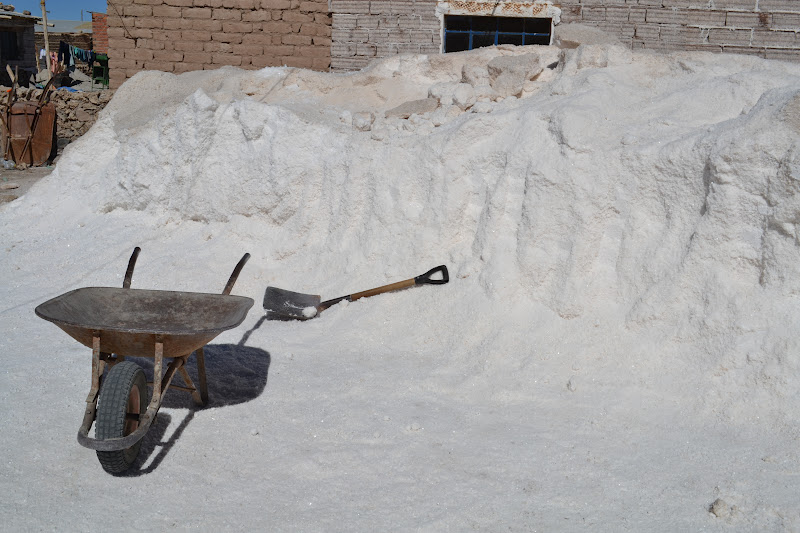
Entering the Uyuni Salt Flats; salt piles ready to be loaded onto the trucks

Naturally occuring honeycomb patterns left by moisture as the salt dries
 

the famous 'perspective' photos - not as easy to perfect as we thought
sunset on the Solar

our group of cheesy, talented jumpers
the hotel on the first night was made entirely of salt - the tables, chairs, beds, walls...

Vicuna's, the prettiest of the lama family
wee!


hundreds of flamingos
"Ladies of the Desert" rock formations
sunrise ("Sol de Manana") view of the Geysers
mmm, the smell of sulfur...
7am dip in the hot springs - the air was way too cold to take off my 7 layers of clothing and get in, however
cruising through the Dali desert, close to the Chilean border
at Laguna Verde with Licancabur Volcano in the background
We finished our trip at the Chilean border and crossed into Chile where we spent one day/night drinking delicious wine and touring the dusty town of San Pedro de Atacama. Over the next few days we made our way via three long buses to Buenos Aires - what a great city! We spent four days eating the world's best steak, drinking wine and visiting the various city highlights before catching our flight to Cape Town :)